
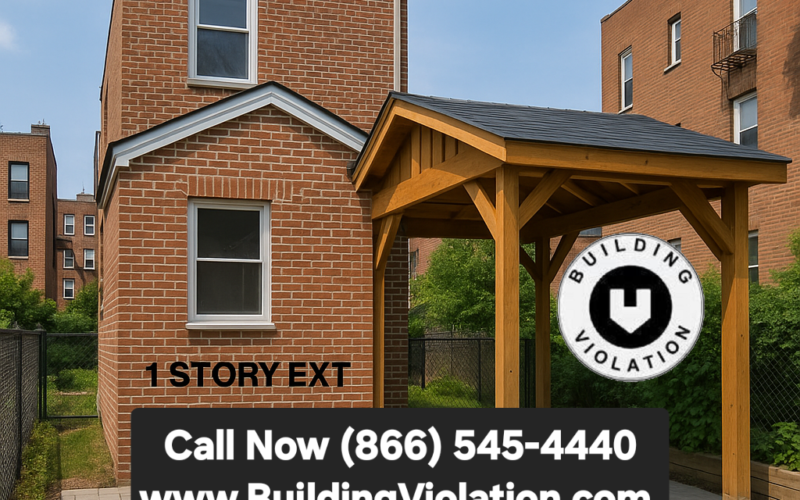
Can I Legalize My Gazebo or Extend My House? A Real NYC Case Study
Homeowners across Brooklyn and Queens run into the same problem: a previous owner (or sometimes the current one) built a “small enclosed patio” or a “side gazebo” without a permit. Then a violation arrives, DOB cites zoning law, and suddenly the question becomes: Can this structure be legalized?
Here is a recent case study from an R5 district in Brooklyn that shows how zoning really works — and how a homeowner turned an illegal enclosed patio into a fully legal house extension + open canopy.
The Problem: Illegal Enclosed Patio in a Required Side Yard
The homeowner had an enclosed patio built along the side of the house facing the secondary street. It looked simple — some walls, windows, a small roof. But zoning saw it differently.
Under ZR 23-12 and ZR 23-44, enclosed structures are not permitted obstructions in required yards. DOB measured the setback, compared it to the zoning map, and concluded the enclosed patio was sitting inside the required open side yard. Once that happens, legalization as-is becomes impossible.
Anything with walls becomes “floor area” and must meet side-yard minimums. This patio did not.
The Zoning “Loophole” That Saved the Project
This property had two side yards:
- A narrow one: 4′-4″
- A wide one: 10′-4″
Zoning requires that at least one side yard remains at the smallest existing dimension — in this case, 4′-4″. But the larger yard can be reduced down to this minimum when enlarging the house.
This is allowed through ZR 54-31, which permits horizontal enlargements of a noncomplying building as long as you do not reduce the smallest existing side yard.
Because the larger yard was 10′-4″, the owner had the legal right to build an enclosed extension up to 6 feet toward the street:
10′-4″ (existing large yard)
– 6′-0″ (new extension)
= 4′-4″ (remaining legal side yard)
Result: A fully legal 1-story enclosed house extension.
What About the Gazebo or Canopy?
After the legal extension is built, the owner may add an open-sided canopy or patio roof in front of it. Zoning allows open porches, posts, beams, and open canopies as permitted obstructions — as long as they have no walls, no screens, and no enclosures.
This gives homeowners the best of both worlds:
- A new legal enclosed room (6 ft extension)
- A weather-protected open patio in front of it
Final Result
Instead of a demolition order, the homeowner ended up with:
- A legal 1-story extension
- A beautiful open canopy
- Full zoning compliance
- No more violations or fines
Thinking About Legalizing Your Patio or Gazebo?
Most illegal gazebos, patio enclosures, and side additions can be resolved — but usually not the way homeowners think. The key is understanding the zoning math and using the allowed enlargement rules properly.
If you’re stuck with a WWP violation or an unwanted demolition order, contact us and we’ll analyze your zoning, setbacks, and extension options the same way.
Building Violation LLC — We Fix What Others Can’t.