
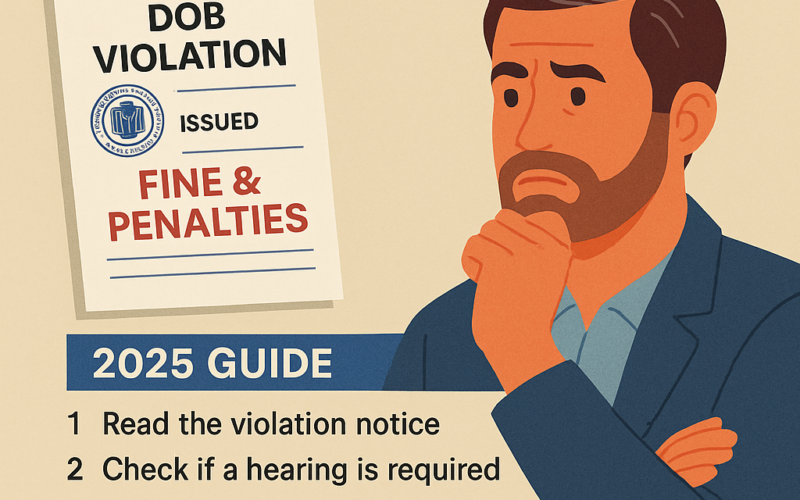
How to Clear an NYC DOB Violation Fast — What Homeowners Must Do Before Fines and Penalties Increase (2025 Guide)
Receiving a violation from the New York City Department of Buildings (DOB) can feel overwhelming. The language is technical, the deadlines are strict, and the potential penalties—civil fines, ECB/OATH judgments, liens, stop work orders—can escalate quickly if you don’t take action.
The good news: most DOB violations can be cleared quickly when you follow the correct sequence. This guide explains exactly what NYC homeowners must do to remove a violation before penalties increase.
The Three Types of DOB Violations (And Why It Matters)
Before you take action, you must understand which type of violation you received. NYC DOB issues:
1. OATH/ECB Summons (Requires a Hearing)
- You must appear at OATH (Office of Administrative Trials and Hearings)
- You may owe a civil penalty
- Does NOT clear the underlying condition — you still must fix the issue
2. DOB Violations (Non-hazardous or Hazardous)
- Class 1 (Immediately Hazardous)
- Class 2 (Major)
- Class 3 (Minor)
Class 1 violations often include:
- Illegal occupancy
- Work without a permit
- Unsafe conditions
These carry the highest penalties and shortest deadlines.
3. “Work Without a Permit” Violations
The most common violation in NYC. This requires:
- Architectural plans
- Engineer review (if structural)
- Filing a legalization (After-The-Fact) permit
- Inspections
No matter which one you received, there is a correct sequence to clear it.
Step 1 — Read the Violation Carefully and Identify What DOB Is Requiring
NYC violation notices are dense, but a few critical elements matter:
- The violation number (needed to track it in BIS or DOB NOW)
- The description of the issue
- The required corrective action
- Whether a hearing is scheduled
- Whether a permit is needed to correct the issue
If the violation says “illegal work performed,” “lack of permit,” or “contrary to approved plans,” you will need an architect and potentially an engineer.
Step 2 — Check If a Hearing Is Required
If the violation is an OATH summons, you must attend the hearing or submit a defense. Missing the hearing results in:
- Automatic guilty determination
- Maximum fine applied
- The violation remaining “open” until corrected
- Possible liens for unpaid penalties
Important: Winning the hearing does not clear the underlying violation. You still must fix the condition cited.
Step 3 — Determine Whether You Need a Permit to Correct the Violation
Most DOB violations require a permit to legalize the work, especially if the issue involves:
- Illegal basement, attic, or garage conversion
- Added walls, rooms, or partitions
- Plumbing or gas lines
- Electrical work
- HVAC changes
- Sheds or extensions
NYC will not clear the violation until the work is:
- Properly filed by a Registered Architect or Professional Engineer
- Approved by DOB
- Inspected and signed off
Step 4 — Hire an Architect, Engineer, or Violation Expediter
Most homeowners cannot navigate DOB filing requirements alone. To clear a violation, filings often include:
- Architectural drawings
- Structural calculations (if needed)
- Zoning checks
- Energy code documentation
- Schedule of existing and proposed conditions
- Objections from the plan examiner and responses
A violation expediter coordinates the entire process and speeds up compliance.
Step 5 — File the Legalization Permit (After-The-Fact Filing)
This is the core step for most “work without a permit” violations.
The steps usually include:
- Architect submits the PW1 application
- Supporting drawings uploaded to DOB NOW
- Plan examiner reviews and issues comments (“objections”)
- Architect responds and resubmits
- Permit is approved
- Contractor pulls the permit
- Contractor performs any required corrective work
- DOB inspector conducts inspection
Once signed off, the violation can be removed from your property profile.
Step 6 — Close Out the Violation in BIS or DOB NOW
After passing inspections, the architect or contractor must update the job status and submit proof of correction. DOB will then mark the violation as “Closed” or “Resolved.”
Important:
- A violation remains on the property until DOB updates the status — not the contractor.
- If there was an OATH fine, it must be paid before full closure.
Step 7 — Understand Penalties If You Delay
In NYC, ignoring a violation leads to:
- Higher civil penalties
- Additional summonses
- Liens against the property
- Problems selling, refinancing, or transferring title
- Stop Work Orders (SWOs)
Title companies routinely block closings due to open DOB violations — even minor ones.
Step 8 — Can You Remove or Reduce the Penalties?
Yes. Depending on the violation, NYC allows:
- Mitigation for first-time offenses
- Penalty reductions after compliance
- Appeals if you believe the violation was issued in error
- Waivers for certain hazardous but corrected conditions
Submitting documentation quickly and showing good faith compliance significantly improves your chances of a reduced penalty.
NYC vs. Florida — Key Difference Homeowners Must Know
In Florida, the biggest threat is the $250/day fine accumulating rapidly.
In NYC, the threat is:
- OATH judgments
- Liens
- Stop Work Orders
- Legal inability to sell the property
This is why NYC violations require structured filings and professional guidance — not just quick fixes.
Summary — How to Clear an NYC DOB Violation Fast
- Identify which type of violation you received (DOB, OATH, WWP)
- Check if a hearing is required
- Determine whether a permit is needed
- Hire an architect/engineer or expediter
- File the After-The-Fact permit
- Pass DOB inspections
- Close the violation in BIS/DOB NOW
Clearing DOB violations is not about luck — it’s about following the correct filing sequence, responding quickly, and using licensed professionals to avoid delays.